
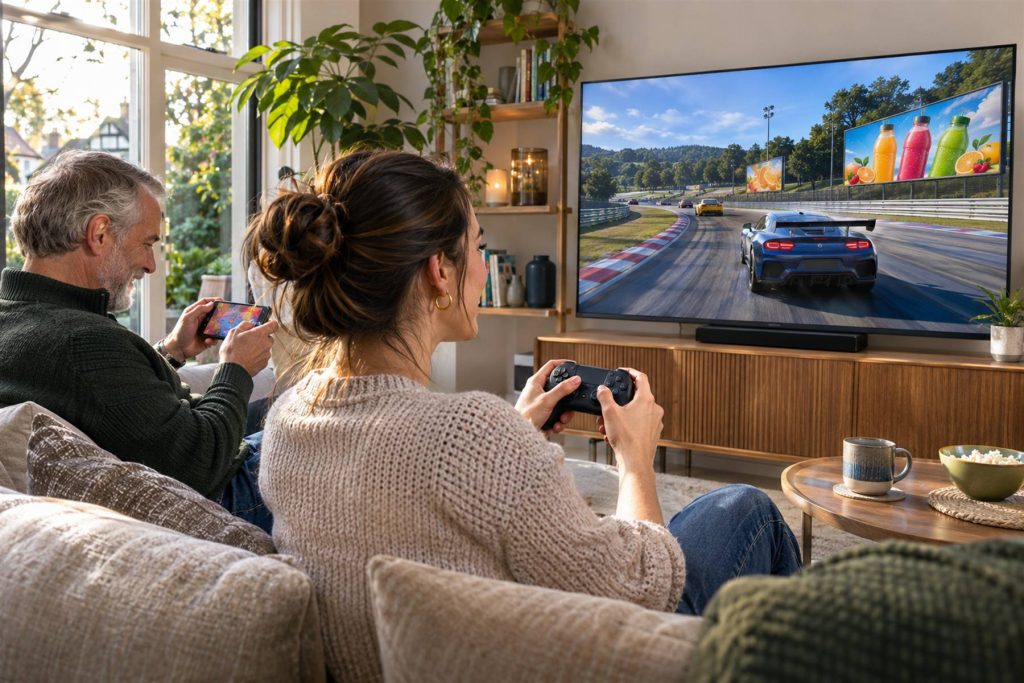
Gaming has become one of the UK’s most popular forms of entertainment, reaching audiences across different ages, interests and devices. Yet, despite its popularity, it remains overlooked in many paid media strategies.
For advertisers, gaming offers opportunities to build brand awareness, encourage engagement and reach consumers in environments where they’re actively involved in the content they’re consuming. As brands diversify their media mix, gaming deserves a place in the conversation.
Gaming is now a mainstream media channel
Gaming is no longer a niche activity associated primarily with younger audiences or console players. According to Ofcom’s Adults’ Media Use and Attitudes report, 53% of UK adults play video games, rising to 85% among 16 to 24-year-olds.
Mobile gaming has contributed significantly to this growth, making games accessible beyond traditional consoles. Meanwhile, platforms such as Roblox and Fortnite have become major entertainment environments, creating opportunities for advertisers to reach engaged audiences.
Reaching audiences across every generation
One of the biggest misconceptions surrounding gaming is that it primarily appeals to young men. In reality, gaming spans generations, with research from gaming media specialist Livewire identifying Millennials as the largest audience. Statista also estimates that women make up about 48% of UK gamers.
Gaming is particularly valuable as media consumption habits change. Ofcom’s Media Nations 2026 research highlights declining linear TV viewing among younger audiences, making gaming another way for brands to maintain visibility while also reaching families and older consumers.
Why gaming creates opportunities for advertisers
Unlike passive media consumption, gaming requires active participation. Players focus on the experience, creating opportunities for brands to engage audiences differently.
Research from IAB UK’s Real Living study found that 63% of UK gamers accept advertising in exchange for free content. This highlights the importance of formats that complement, rather than interrupt, gameplay, particularly those that offer something in return.
Rewarded video advertising, for example, allows players to watch an advert in exchange for an in-game benefit, while interactive formats encourage more direct engagement. Research from Livewire also suggests that family co-play creates opportunities to reach households during periods of focused engagement, particularly at weekends.
How gaming advertising works
Gaming advertising shares similarities with programmatic display and paid social. Campaigns use audience data to identify relevant consumers, match them to available advertising inventory and deliver messages through formats suited to different gaming environments.
For example, a brand might appear on a virtual billboard in a racing game, deliver an opt-in video advert in a mobile game or create an interactive experience. Depending on the platform, targeting can incorporate audience characteristics, devices, gaming behaviour and genres.
Performance can then be assessed through delivery, attention and engagement metrics, alongside brand lift studies measuring changes in awareness or consideration.
Targeting the right audience, place and time
Like other advertising channels, gaming works best when targeting is informed by clear campaign objectives. Understanding who plays, where they spend their time and when they’re most active helps advertisers identify relevant opportunities.
Audience targeting can incorporate age groups, devices, platforms, genres and gameplay behaviour, while regional targeting helps brands build awareness across specific geographic markets. Complementary channels such as paid social and online video can provide greater postcode-level precision where required.
Timing is another consideration, with evenings, weekends and school holidays particularly relevant for family and leisure campaigns. Livewire’s research also identifies Saturday evenings as an important period for family co-play.
However, gaming environments often include younger audiences, making responsible advertising essential. Campaigns must comply with the CAP Code and relevant requirements of the ICO Children’s Code, with appropriate age safeguards and creative considerations.
Choosing the right gaming advertising formats
Gaming offers several formats across mobile, PC and console, each suited to different campaign objectives.
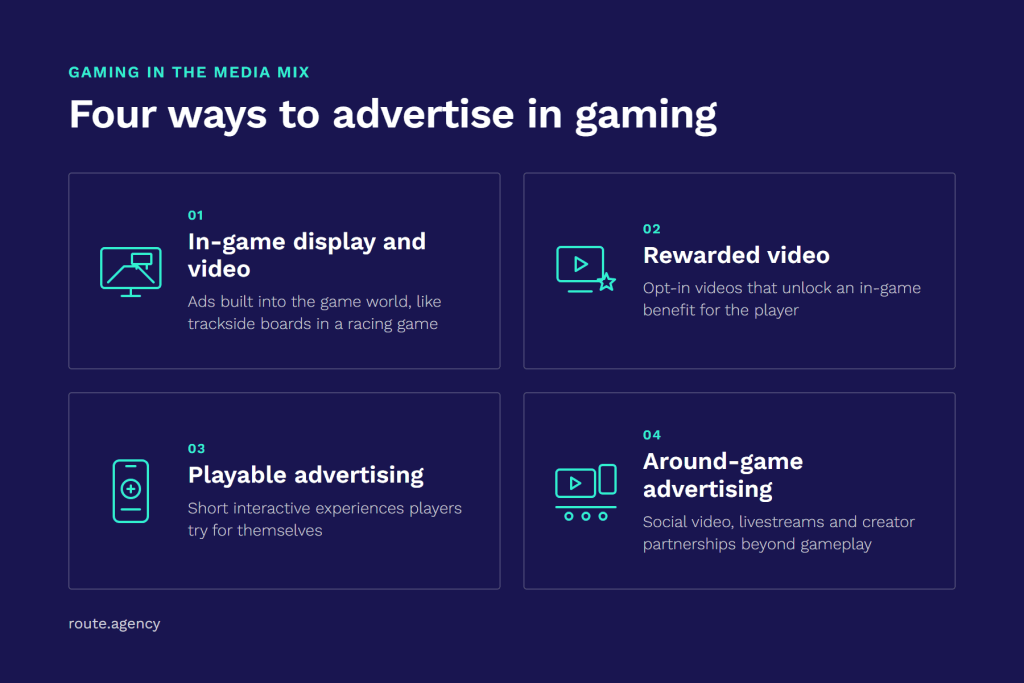
- In-game display and video. Advertising integrated into the gaming environment, such as digital billboards in racing games or real-world sponsor branding appearing on the Octagon canvas in EA Sports UFC games. These placements help build brand familiarity without interrupting gameplay.
- Rewarded video. Opt-in advertising offering an in-game benefit in exchange for watching a video.
- Playable advertising. Short interactive experiences encouraging participation and memorable brand engagement.
- Around-game advertising. Content across TikTok, YouTube Shorts, Instagram Reels, livestreams and creator partnerships, extending campaigns beyond gameplay.
The right format depends on the campaign objective, whether that’s building familiarity through repeated exposure or encouraging more direct interaction with a brand.
Measuring gaming advertising performance
Like any paid media channel, gaming should be measured against clear objectives. Reach and awareness can be assessed through impressions, frequency and viewability, while video completion rates and interactive engagement provide insight into attention.
Brand lift studies can measure changes in awareness and consideration against a control group, while tagged landing pages and promotional codes help connect gaming activity to website visits and conversions.
Established guidance, including the IAB and MRC’s Intrinsic In-Game Measurement Guidelines, provides a framework for measuring advertising within gaming environments.
Where gaming fits in a multi-channel strategy
Gaming shouldn’t replace established advertising channels. Instead, it can complement paid social, search, video and out-of-home by building familiarity with audiences through repeated exposure and engagement.
This supports the principle of balancing long-term brand building with shorter-term activation, explored by Binet and Field in The Long and the Short of It. Rather than treating gaming in isolation, advertisers should consider how it contributes to wider campaign objectives.
Bringing gaming into the media mix with Route
At Route, we approach gaming like any other advertising opportunity, starting with the audience, understanding the objectives and identifying where the channel can add value.
A test-and-learn approach lets us assess formats, measure performance and understand the impact on brand awareness before scaling investment. By reporting gaming alongside other channels, we can evaluate its contribution to the wider media plan.
Interested in exploring how gaming could fit into your next campaign? Get in touch with Route to discuss how we can help you reach audiences across the right mix of channels.